
ACL Rehab & Return to Sport
You've been going by the calendar. Nobody's measured the knee.
Most ACL rehab is timed, not tested. You're four months out, so you do four-month things. We measure what your knee can actually produce — force plates, dynamometry, hop and agility testing — and build from the number instead of the date.
Board-certified specialists · La Habra · Costa Mesa · Long Beach
Two people call us most.
“I think I'm behind.”
You're three to six months post-op. Somebody told you you're behind, or you watched enough Instagram to decide it yourself. You don't know what you're supposed to be able to do by now, nobody has shown you a number, and the exercises haven't changed in six weeks.
You might be behind. You might be exactly where you should be. Right now nobody in the room can tell you which, because nobody has measured it.
“They cleared me. I don't feel ready.”
Your surgeon signed off. Your PT signed off. And you still don't trust the leg when you plant on it.
That instinct is worth listening to. Clearance is usually based on time and on how the knee looks — not on what your leg can actually produce, measured both against your other side and against your own body weight. Those are different questions, and only one of them tells you what happens when you cut at full speed.
“I just felt like I wasn’t doing ‘enough’ and wanted to work with someone who specializes in ACL recovery. I was very impressed when I saw that he does ‘strength testing.’”
Joey Gonzalez · ACL & meniscus, wildland firefighter · Google review
Step one
First, we measure you.
Ninety minutes. The same battery for everyone who walks in — and you leave with every number.
Strength — against your other leg, and against your body weight
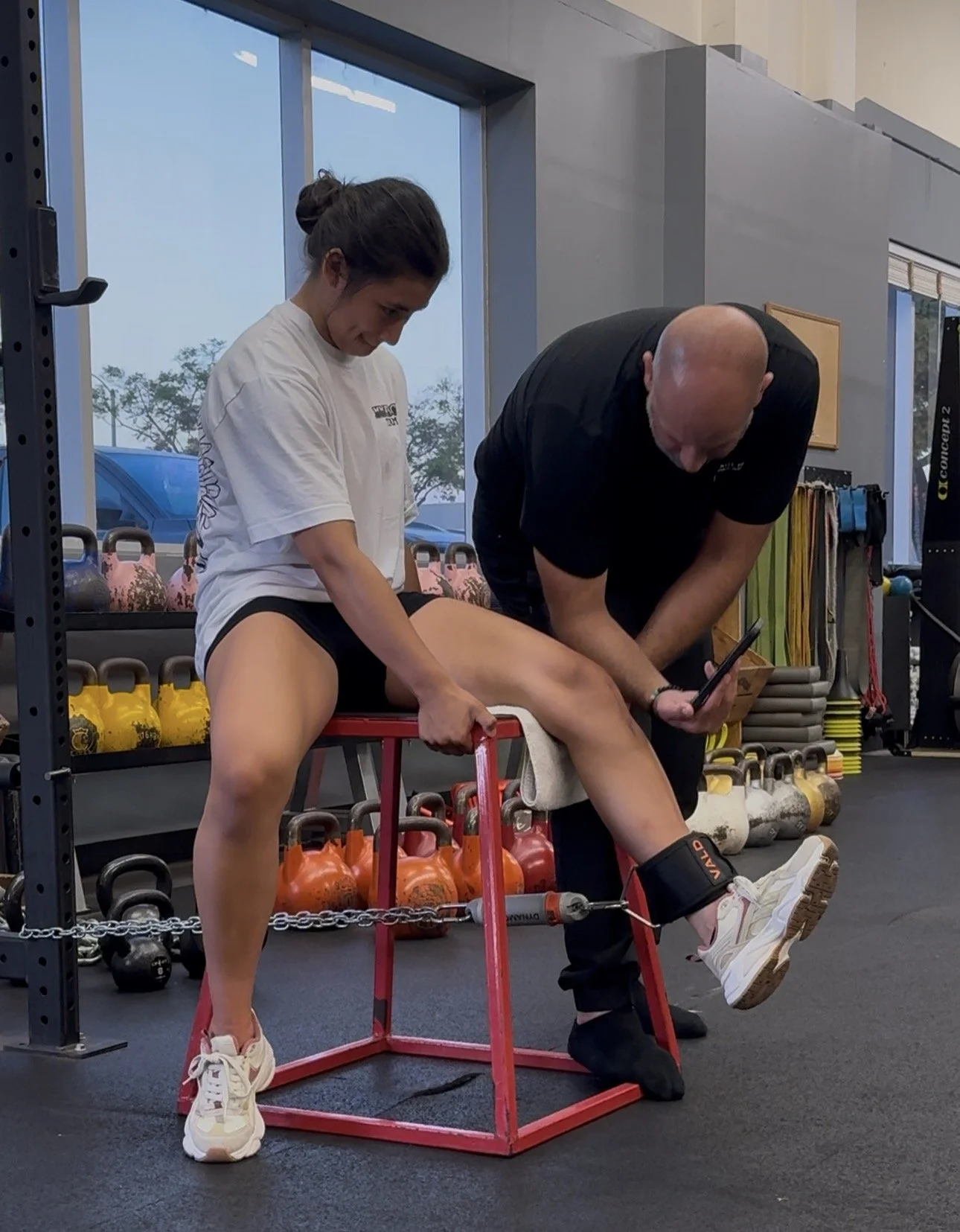
Isometric dynamometry on the VALD system. We measure two things here, and most people have only ever been told about the first.
The first is your Limb Symmetry Index — what your surgical leg produces compared with your other one. It's the number most clinics report, and it matters.
But symmetry on its own can lie to you. If both legs are weak, you can be perfectly symmetrical and still nowhere near ready — you've matched a leg that isn't strong enough either. That's how someone passes a symmetry test and gets hurt anyway.
So we also measure strength relative to your body weight. That's an absolute standard rather than a comparison, and it answers the question symmetry can't: can this leg handle you — your mass, at speed, changing direction.
You need both numbers. Symmetry without an absolute is half a picture, and it's the half most rehab stops at.
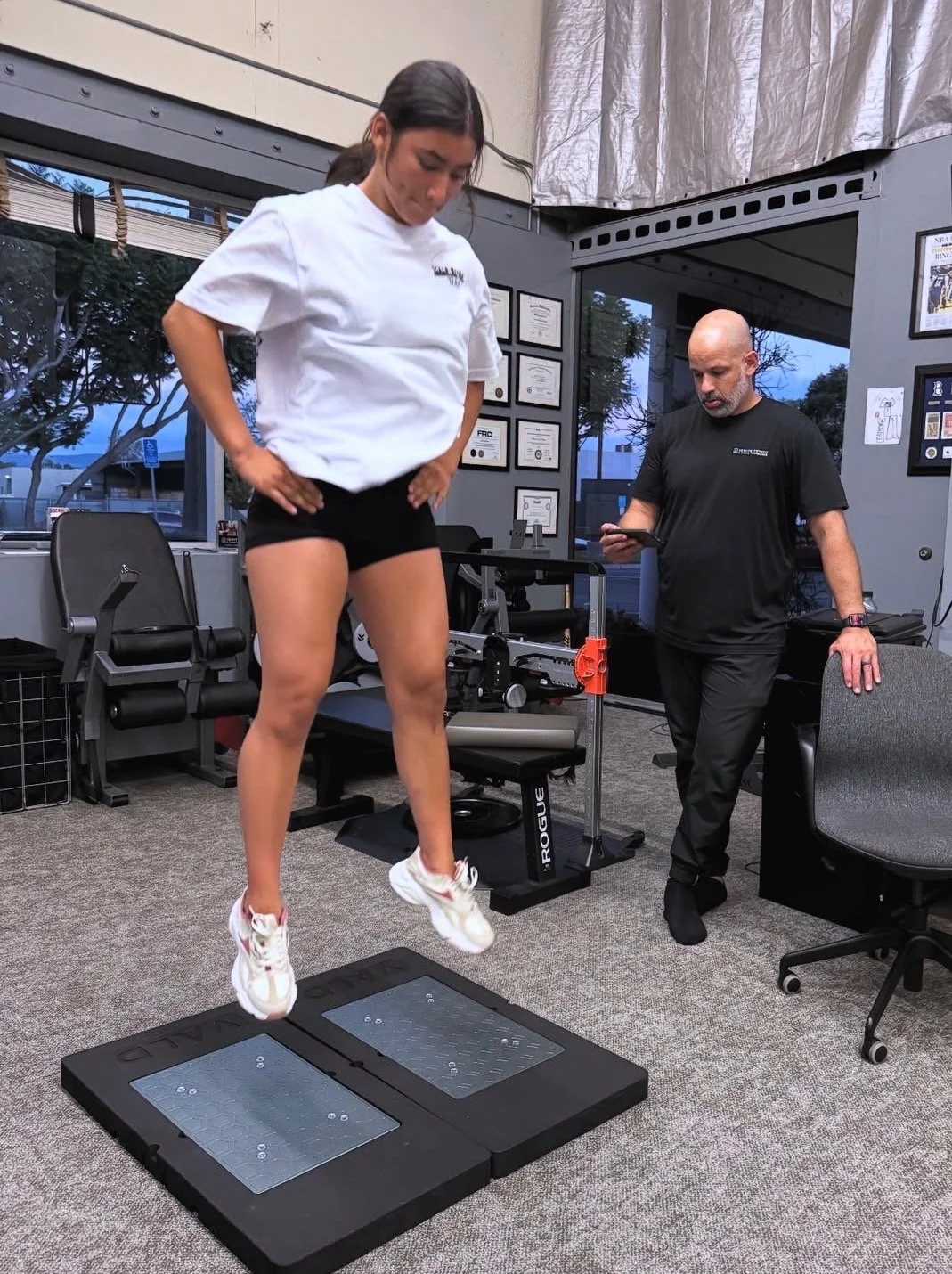
Force plate testing
Jump and strength testing on force plates. How much force you make, how fast you make it, how you absorb it on landing, and how evenly you're loading the two sides. Landing is where re-injuries happen and it's invisible to the naked eye — you can look completely normal and still be dumping the load into one leg.
Head-to-toe range of motion and mobility screen
Not just the knee. Ankle and hip restrictions are what force the knee to do things it shouldn't have to.
Hop testing battery
The standard return-to-sport hop tests, scored against your uninvolved side.
Agility and sport-specific movement
Cutting, decelerating, and the actual demands of your sport. The last quality to come back, and the first one that gets skipped.
“The facility has a machine which can measure and track strength differences of all your different muscles, and my first measurements revealed some serious imbalances.”
Max McDonald · Google review
Step two
Then decide what happens next.
Same measurement every time. Four different ways to use it — find the line that sounds like you.
Rehab the whole way with us
This is you if: you want us to take you from where you are now to back in your sport.
Physical therapy with strength and conditioning built into it, not bolted on afterward. Early on that means restoring range and waking the quad back up. Later it means barbells, box jumps, and learning how to decelerate. Same clinicians and one continuous plan the whole way through — so nobody hands you off at month three with a photocopied sheet.
You're re-tested at every checkpoint, not just once. Every progression is a decision made from data rather than the calendar: you see the numbers, and you move forward when the numbers say you're ready.
A full hour, one-on-one, with a doctor of physical therapy · La Habra, Costa Mesa, Long Beach
Just the numbers
This is you if: you want to know exactly where you stand, and that's it for now.
You come in once, get the full battery, and leave with every number we record.
If you're ready, we'll tell you. If you're not, we'll tell you exactly what's missing — and you'll leave with an intro program written from your own numbers and built for your own sport to start closing it. Not a handout, not a generic protocol.
No obligation to keep working with us. Plenty of people take their numbers and their program back to their own physical therapist, and that's a completely fine outcome — it's why in-network clinics send us patients they can't test on-site.
One visit · 90 minutes · all your data · individualized intro program included
Keep your PT. Add us.
This is you if: you're settled at another clinic, or insurance makes that the only realistic option, but you want our eyes on the plan.
You don't have to leave to get this. We stay on your case as your second set of eyes for the whole recovery: reviewing where you actually are, re-testing you at the checkpoints that matter, and telling you what to ask for next.
You get the decisions made by people who do this every day, while your visits stay where they are.
We already work this way with clinics who know that testing isn't their strength and send patients to us for it. If that sounds like your clinic, bring them into the conversation — most are glad to have it.
Tell us where you're being treated and what's worrying you, and we'll tell you honestly whether this makes sense for your situation.
ASX — the Athlete Strength Experience
This is you if: you're through rehab and don't want to lose what you just spent a year building.
Small-group strength and conditioning, on-site. Led by a strength coach, programmed by a doctor of physical therapy.
This is where you go when rehab is finished but the training shouldn't be — which is also where a lot of ACLs get re-torn, because the strength work stops on the same day the visits do.
You don't have to have torn anything to be here. The training that brings a knee back is the same training that keeps one healthy, so ASX is open to any athlete who wants to lower their risk rather than rehab it.
“There is no one size fits all and he does not operate based off ‘elapsed time’ post surgery as humans are all different. He is super knowledgeable on ACL injuries.”
Thomas L. · Yelp review · Read all 80 reviews
Why we're the ones to do this
A board-certified orthopedic specialist who teaches ACL rehab to other physical therapists. Not a clinic that treats ACLs among other things — a clinic other clinicians learn this from.
We own the testing equipment. VALD force plates and dynamometry, on-site at our locations. Not a referral out, not an estimate, not a guess from watching you squat.
A full hour, one-on-one, with a doctor of physical therapy. Not fifteen minutes of hands-on time inside a sixty-minute slot you're sharing with two other people.
A real gym. You cannot rebuild a knee for sport with a resistance band and a treatment table.
Twelve to fifteen months of ACL programming already built, so the work you do between sessions is programmed too, not improvised.
Common questions
I already have a physical therapist.
Good — keep them. Option 03 exists for exactly this, and the testing is standalone. Plenty of people work with us alongside their clinic rather than instead of it.
Do you take insurance?
We're out-of-network, and the number worth comparing is the total cost of getting back to your sport rather than the price of one visit. An in-network clinic is typically fifteen to twenty minutes of actual therapist time, three times a week for six weeks. We're a full hour, one-on-one, and most people need far fewer visits to get further. We provide superbills you can submit for out-of-network reimbursement, and we accept HSA and FSA.
I'm two years out. Is it too late?
No. A meaningful share of the people we test are years past surgery and never got the strength back on that side. That gap doesn't close on its own, and it doesn't close because time passed.
I didn't have surgery.
Non-operative ACLs belong here too. Same testing, same criteria, same question — what can the knee actually do.
How far along do I need to be for testing to be worth it?
Generally from about three months post-op onward. Earlier than that, call us and we'll tell you honestly whether it's worth your money yet.
What if I don't live near you?
People travel in for testing. It's a single ninety-minute visit, and you leave with your numbers and a program you can run wherever you train. Plenty of athletes come once, go do the work at home, and come back to be re-tested.
Start with the number.
Whatever you decide after that gets easier once you know where you actually stand.